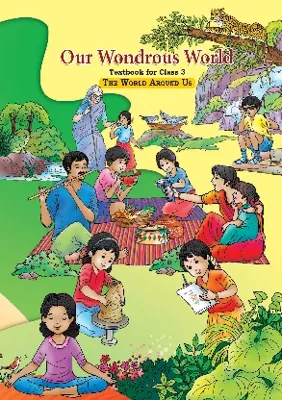
The World Around UsClass 3

Our Wondrous World

Environmental Studies12 Chapters

Chapter notes

What you'll learn in Our Wondrous World

A quick revision map of Our Wondrous World — the core idea and five key takeaways from each chapter. Tap any chapter to read the full NCERT PDF and detailed notes.

01

Family and Friends

Chapter 1 of the Class 3 The World Around Us (EVS) NCERT textbook (Our Wondrous World), "Family and Friends", introduces children to the different members of a family, the loving relationships and mutual support they share, and the joy of playing, singing, helping, and spending time together — told through the everyday life of a girl named Bela and her family.

  • 1Bela's family includes her parents, Dadiji (grandmother), Dadaji (grandfather), elder brother Banku Bhaiya, and baby brother Bishu, plus their pet dog Shiru.
  • 2Families come in different sizes — big and small — and all are special; the chapter encourages children to identify their own family members and relationships.
  • 3Traditional games like chhupan-chhupai (hide and seek), antakshari, snakes and ladders, and pitthoo are introduced as activities shared across generations.
  • 4Grandparents pass down songs, games, and life skills to grandchildren, showing the value of learning from elders.
  • 5Every family member has a role in daily chores — the chapter asks children to observe and record who does what work at home.
02

Going to the Mela

Chapter 2 of the Class 3 The World Around Us (EVS) NCERT textbook (Our Wondrous World), "Going to the Mela", follows Nita, Radha, and their neighbours Sneha and Rohit as they travel by bus to a local mela, exploring themes of travel safety, caring for elders, community, and responsible behaviour at a public fair.

  • 1Nita, Radha, Sneha, and Rohit travel to the mela by bus number 401; Dadiji gets a reserved seat for older passengers.
  • 2Road safety rules taught: walk carefully watching vehicles in both directions, do not put hands or head out of the bus window.
  • 3At the mela entrance there is a map showing stall locations, and a Lost and Found booth run by volunteers.
  • 4Emergency services including an ambulance, police jeep, and fire engine are parked at the mela ground.
  • 5The children buy toys like spinning tops, puppets, and phirkis, enjoy the merry-go-round and giant wheel, and watch a magic show.
03

Celebrating Festivals

Chapter 3 of the Class 3 The World Around Us (EVS) NCERT textbook (Our Wondrous World), "Celebrating Festivals", follows a boy named Rishi as he travels from Jammu to a Himalayan village to visit relatives, where he discovers how different regions of India celebrate spring through flowers, food, and festivals like the Kashmir Tulip Festival, Vishu in Kerala, and Sarhul in Jharkhand.

  • 1Rishi travels from Jammu to a Himalayan village by bus and notices colourful flowers and tall trees on the way.
  • 2In Kashmir, tulips bloom in spring and people celebrate the Kashmir Tulip Festival.
  • 3Rishi shares that buransh (Rhododendron) flowers bloom in spring at his home, and mustard and buransh flowers are placed at doorsteps as a tradition.
  • 4Chiya's friend Unni from Kerala celebrates Vishu using yellow amaltas flowers, fruits, and vegetables to make Vishu Kani.
  • 5Sarhul is a spring festival in Jharkhand where people walk in procession to the sakhua tree, carry sakhua flowers, and celebrate with singing and dancing.
04

Getting to Know Plants

Chapter 4 of the Class 3 The World Around Us (EVS) NCERT textbook (Our Wondrous World), "Getting to Know Plants", introduces children to the five main types of plants — trees, shrubs, herbs and grasses, climbers, and creepers — through the story of three friends named Gopu, Simmi, and Raj, and guides them to observe parts of a plant such as roots, stem, leaves, flowers, fruits, and seeds, while exploring how everyday foods like rice, wheat, dal, and sugarcane all come from plants.

  • 1Plants come in five types: trees, shrubs, herbs and grasses, climbers, and creepers
  • 2Trees have a big woody trunk, many branches, and roots that go deep into the soil
  • 3Shrubs are medium-sized with several woody stems growing close to the ground — hibiscus, rose, tulsi, and curry leaf are examples
  • 4Grasses are a type of herb with soft hollow stems and thin flat leaves; bamboo and sugarcane are tall grasses
  • 5Climbers grow upward using other plants or walls for support (money plant, jasmine), while creepers spread along the ground (pumpkin, watermelon)
05

Plants and Animals Live Together

Chapter 5 of the Class 3 The World Around Us (EVS) NCERT textbook (Our Wondrous World), "Plants and Animals Live Together", teaches children that plants and animals share the same spaces and depend on each other — animals live on, around, and even under plants for food, shelter, and rest, while the chapter also explores what soil is made of and the many creatures that live in it.

  • 1Animals live on, around, and under plants — using them for food, shelter, and rest.
  • 2Soil is made from broken rock pieces, old leaves, roots, stems, and living and dead insects.
  • 3Insects like ants, termites, beetles, and grasshoppers live on the top layer of soil.
  • 4After rain, earthworms and millipedes appear in the soil, and more plants sprout.
  • 5Birds like tailorbirds stitch leaves to build nests; owls and barbets use tree hollows.
06

Living in Harmony

Chapter 6 of the Class 3 The World Around Us (EVS) NCERT textbook (Our Wondrous World), "Living in Harmony", teaches children how humans, animals, and plants depend on one another for food, shelter, care, and companionship, using stories and activities to show that living things help each other grow and thrive.

  • 1Animals help plants by dispersing seeds and making the soil fertile through their waste, helping plants grow and spread far.
  • 2Squirrels accidentally plant thousands of trees by burying nuts and forgetting where they hid them.
  • 3Plants give humans shade, shelter for animals, wood, medicine, fibre, fruits, and fresh air.
  • 4Humans take care of animals and plants by giving them water, food, and shelter, and should not hurt animals even if scared of them.
  • 5The chapter includes a true story about children in Valparai, Tamil Nadu, who welcome Grey Wagtail birds every winter with posters and sweets.
07

Water — A Precious Gift

Chapter 7 of the Class 3 The World Around Us (EVS) NCERT textbook (Our Wondrous World), "Water — A Precious Gift", teaches children how rainwater reaches the earth, gets stored in streams, ponds, wells, and underground sources, travels to homes through pipes and tanks, is kept in vessels of different materials, and must be conserved and not wasted.

  • 1Rain is the main source of water; it soaks into the soil, fills wells and groundwater, and flows into streams, ponds, lakes, and rivers.
  • 2Water reaches homes through pipes and rooftop tanks, wells and borewells, or is delivered by water tankers.
  • 3People store water in vessels made of different materials: clay, copper, brass, steel, aluminium, glass, and plastic.
  • 4Waste water after use cannot be used for drinking or cooking but can be reused to water plants or flush toilets.
  • 5Water is considered sacred because it is essential for survival, and in some areas people must walk long distances to get it.
08

Food We Eat

Chapter 8 of the Class 3 The World Around Us (EVS) NCERT textbook (Our Wondrous World), "Food We Eat", teaches young learners why we need food and water, the importance of eating a variety of foods including vegetables, fruits, grains, pulses, and nuts for a strong and healthy body, how food comes from different parts of plants and from animals, and how seasonal and regional differences shape what people eat across India.

  • 1Eating a variety of foods — vegetables, fruits, grains, pulses, nuts, and milk products — helps build a strong and healthy body.
  • 2The story of Shirin shows that practising hard AND eating a balanced diet together help achieve goals like running faster.
  • 3Chhappan Bhog is a traditional festive food offering with 56 varieties representing six tastes: sweet, spicy, astringent, sour, salty, and bitter.
  • 4We eat different parts of plants: leaves (spinach, methi), fruits (mango, guava), roots (carrot, radish), and stems (potato, ginger).
  • 5Foods from animals include milk, curd, ghee, cheese, paneer, honey, eggs, and meat.
09

Staying Healthy and Happy

Chapter 9 of the Class 3 The World Around Us (EVS) NCERT textbook (Our Wondrous World), "Staying Healthy and Happy", teaches children simple daily habits for keeping their bodies and minds clean and healthy, including hygiene routines, outdoor play and exercise, safe play practices, and stranger safety.

  • 1Brush teeth twice a day — once after waking up and once before bed — and rinse the mouth after every meal.
  • 2Wash hands with soap after using the toilet and after coming home from outdoors.
  • 3Drink 6 to 8 glasses of water daily and sleep for at least 8 hours.
  • 4Neem, babool, and karanj twigs were traditionally used to clean teeth — this Indian datun practice inspired the modern toothbrush.
  • 5Exercise makes the heart work harder and better; outdoor play like skipping, running, and jumping builds fitness.
10

This World of Things

Chapter 10 of the Class 3 The World Around Us (EVS) NCERT textbook (Our Wondrous World), "This World of Things", teaches young learners to observe everyday objects closely, identify what materials they are made of and where those materials come from, and understand key properties of materials such as transparency, flexibility, hardness, and whether they are solid, liquid, or gas, as well as the difference between natural and artificial things.

  • 1Metals are extracted from rocks and sediment called ore dug from inside the Earth.
  • 2Glass is mostly made of sand and is transparent, meaning you can see through it clearly.
  • 3Materials can be transparent (clear glass), translucent (partially see-through), or opaque (cannot see through, like wood).
  • 4Wood is hard and rigid while fabric is soft and flexible, which is why each material is used for different objects.
  • 5Objects can be classified as solids (keep their shape), liquids (flow and take the shape of a container), or gases (float freely like air).
11

Making Things

Chapter 11 of the Class 3 The World Around Us (EVS) NCERT textbook (Our Wondrous World), "Making Things", teaches children how everyday objects like clay pots and bricks are made by hand, introduces patterns found in nature and Indian pottery, and explores the different materials people use to build houses.

  • 1Clay is made ready for pot-making by wetting, pounding, and kneading it until it is neither too wet nor too dry, then shaping it on a spinning potter's wheel.
  • 2The potter's oven used to bake and harden clay pots and bricks is called a kiln.
  • 3Bricks are shaped using moulds and then baked in a kiln; they are used to construct buildings such as houses, schools, and hospitals.
  • 4Patterns in nature, like the stripes on a zebra, the spots on a leopard, and leaf arrangements on a neem tree, inspire artists who decorate pottery.
  • 5In warm areas of India, traditional mud houses are made using natural materials like grass, wood, and cow dung to stay cool and keep insects out.
12

Taking Charge of Waste

Chapter 12 of the Class 3 The World Around Us (EVS) NCERT textbook (Our Wondrous World), "Taking Charge of Waste", teaches children how everyday activities create waste and how each of us can help manage it through three key practices — Reduce, Reuse, and separate waste into green and blue dustbins for composting and recycling.

  • 1Everyday activities like using packaged food and plastic bags create household waste such as peels, wrappers, and old bottles.
  • 2Burning plastic releases harmful gases, and wastewater on roads increases mosquitoes that spread diseases.
  • 3Reducing waste means buying only what you need and avoiding extra packaging like plastic bags and bottles.
  • 4Reusing means giving old items a new purpose — old sarees become quilts, old newspapers wrap gifts, and used paper is turned over for rough work.
  • 5Green dustbins collect rotting waste like leaves and vegetable peels that become compost; blue dustbins collect metal, glass, plastic, and paper for recycling.

Want offline access with notes & solutions?

Download CBSE Prepmaster for free — includes NCERT solutions, flashcards, mock tests & more.

Download Free App