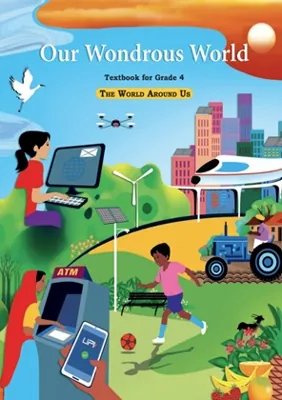
The World Around UsClass 4

Our Wondrous World

Environmental Studies10 Chapters

Chapter notes

What you'll learn in Our Wondrous World

A quick revision map of Our Wondrous World — the core idea and five key takeaways from each chapter. Tap any chapter to read the full NCERT PDF and detailed notes.

01

Living Together

Chapter 1 of the Class 4 The World Around Us NCERT textbook (Our Wondrous World), "Living Together", introduces students to the idea of community as a space of togetherness and interdependence through the story of a boy named Chandan, his village, and the Van Mahotsav tree-planting festival. Students explore how people, places, and public spaces are connected, how communities cooperate to solve problems, and why caring for shared spaces matters. Download the PDF and read a summary and Q&A below.

  • 1Chapter 1 is titled 'Living Together' and is part of Unit 1 — Our Community in the Our Wondrous World textbook.
  • 2The chapter follows Chandan, a boy who lives in a village and shows readers how people and places in a community are connected.
  • 3Public places — parks, schools, health centres, roads, markets — are shared by everyone and kept up through community effort.
  • 4Van Mahotsav (Tree Planting Festival) is celebrated in India from 1 July to 7 July every year during the rainy season.
  • 5In the story, villagers with different occupations (mason, nursery owner, electrician) each contribute a skill to repair and beautify a park.
02

Exploring Our Neighbourhood

Chapter 2 of the Class 4 The World Around Us NCERT textbook (Our Wondrous World), "Exploring Our Neighbourhood", follows Navya and her grandfather on a bus ride home through their neighbourhood, introducing children to community places like the post office, hospital, bank, and ATM, while also covering how communication and transport have changed over time, cardinal directions for map-reading, and the basics of saving money. Download the PDF and read our summary and Q&A below.

  • 1Navya takes the market route home by bus with her grandfather (Dada ji) and observes post offices, hospitals, banks, metros, and flyovers
  • 2Post offices sort letters by region and deliver them; Dada ji used them to write to his brother in another city when he was young
  • 3Long ago people communicated via drumbeats, rock carvings, and pigeons; later the postal service, telephone, radio, TV, and now the internet
  • 4Metro trains travel very fast and flyovers let vehicles pass above busy roads and crossings, saving travel time
  • 5Banks keep money safe and help people save for the future; ATMs (Automated Teller Machines) let people withdraw money anytime without waiting in queues
03

Nature Trail

Chapter 3 of the Class 4 The World Around Us NCERT textbook (Our Wondrous World), "Nature Trail", takes students on an exciting field trip to the forests of Pachmarhi, Madhya Pradesh, where they observe land animals, water animals, birds, insects, and leaves while learning about their unique features and interdependence. The chapter blends nature walks, safety rules, bird diaries, the "Web of Life" game, and leaf-rubbing activities. Download the PDF and read the summary and Q&A below to explore every activity and concept in this chapter.

  • 1The nature trail is set at Pachmarhi, Madhya Pradesh — students are encouraged to locate it on the map of India.
  • 2Abha Didi, a nature scientist, guides students through the forest and explains plant and animal features.
  • 3Safety rules for visiting a zoo or forest include: do not tease or feed animals, do not damage trees/flowers, do not bring polythene bags or pets, and do not throw garbage.
  • 4The Indian Giant Squirrel is a large, red-coloured squirrel found in Pachmarhi.
  • 5Leaves differ in colour, shape, texture, and vein pattern — two types of vein arrangement are shown; the Leaf Autograph (leaf-rubbing with a crayon) activity reveals these patterns.
04

Growing up with Nature

Chapter 4 of the Class 4 The World Around Us NCERT textbook (Our Wondrous World), "Growing up with Nature", follows Reena and Amit on a village trip for a harvest festival where they discover how communities live in harmony with nature — from Palash (flame of the forest) trees and clay houses to natural dyes, traditional grain storage, and herbal mosquito repellents. Download the PDF and explore the chapter summary and Q&A below.

  • 1The Palash tree is called the 'flame of the forest' because its orange-red flowers make the entire forest look reddish-orange from a distance.
  • 2Village houses are made from clay, hay, and cow dung, and walls are painted with rice flour and water dye.
  • 3Natural dyes can be made at home by boiling beetroot, hibiscus, or marigold in water for 30 minutes to an hour.
  • 4Grains are kept pest-free using earthen pots lined with neem leaves and bamboo baskets coated with cow dung.
  • 5The Jenu Kuruba tribe of Karnataka sings songs to apologise to bees when collecting honey, showing deep respect for nature.
05

Food for Health

Chapter 5 of the Class 4 The World Around Us NCERT textbook (Our Wondrous World), "Food for Health", introduces students to food groups, the six tastes of Ayurveda (shad rasa), balanced food plates, junk food, cooking methods, and the importance of water through a lively school food festival story. Download the PDF and read the chapter summary and Q&A to understand how energy-giving, body-building, and protective foods keep us healthy.

  • 1Three food groups: energy-giving (rice, wheat, millets), body-building (pulses, milk, eggs, fish), and protective (fruits and vegetables)
  • 2Shad rasa (six tastes) in Ayurveda: sweet, sour, salty, pungent, bitter, and astringent — all present in Ugadi Pachadi
  • 3Millets like jowar, bajra, ragi, and jau are nutrient-rich super foods highlighted in the chapter
  • 4Junk foods (soft drinks, chips, pizza, burgers, packaged food) are high in oil, salt, and sugar and should be limited
  • 5A balanced food plate has the most protective foods (fruits and vegetables), then body-building, then energy foods
06

Happy and Healthy Living

Chapter 6 of the Class 4 The World Around Us NCERT textbook (Our Wondrous World), "Happy and Healthy Living", teaches children how food travels from farm to plate, how to eat mindfully, why physical activity and sleep matter, and how to recognise safe versus unsafe touch. Download the PDF and read our summary and Q&A to help your child prepare for class discussions and activities on balanced, joyful daily habits.

  • 1Food grains like rice and wheat go through a long journey from farm to plate, involving farmers, cattle, shopkeepers, soil, water, and sunlight.
  • 2Students connect food items to their ingredients and identify which elements (soil, water, farmer, earthworm) help a grain in its journey.
  • 3India celebrates gratitude to Mother Nature through festivals like Makar Sankranti, Lohri, Onam, Akshay Tritya, and Raja Utsav.
  • 4The mindful eating activity uses a peanut — students feel, taste, and chew it slowly with eyes closed to experience all senses.
  • 5Wasting food disrespects the hard work of everyone who helped bring it to our plate; the chapter has a week-long food record activity.
07

How Things Work

Chapter 7 of the Class 4 The World Around Us NCERT textbook (Our Wondrous World), "How Things Work", introduces students to the science of spinning, floating, and sinking through hands-on activities with everyday objects like coins, bangles, tops, aluminium foil, and paper boats. Students observe how shape and weight affect whether things spin or stay balanced and whether objects float or sink in water. Download the PDF and read the chapter summary and Q&A below.

  • 1Students spin coins, bangles, pencils, erasers, and wooden tops to observe which objects spin and which do not.
  • 2Homemade cardboard spinners show that a toothpick placed at the centre makes the spinner spin better than one placed off-centre.
  • 3A square card spun fast appears circular, showing that shape seems to change when an object spins quickly.
  • 4Mahatma Gandhi used a charkha (spinning wheel) to spin cotton fibre into thread.
  • 5Spinning tops have been used in India for thousands of years; the lattu is a popular Indian top traditionally made of wood.
08

How Things are Made

Chapter 8 of the Class 4 The World Around Us NCERT textbook (Our Wondrous World), "How Things are Made", follows a girl named Pihu as she discovers that paper comes from trees and learns to make recycled paper at home using old newspapers, water, and fenugreek seeds as a binding agent. The chapter also introduces natural dyes, different types of paper and their uses, the Braille system, and the 5Rs of waste management — Refuse, Reduce, Reuse, Repurpose, and Recycle. Download the PDF and explore chapter summaries and Q&A below.

  • 1Paper is made from wood pulp; making it requires cutting many trees, large amounts of water, and energy.
  • 2Recycled paper can be made at home using old newspapers, water, and fenugreek seeds as a binding material.
  • 3Natural dyes from turmeric, spinach, beetroot, and henna can be used to colour recycled paper safely.
  • 4In earlier times people used cloth, leaves, wooden boards, and palm leaves (talapatra) instead of paper.
  • 5Banana fibre is an environment-friendly alternative material that can be used to make paper and save trees.
09

Different Lands, Different Lives

Chapter 9 of the Class 4 The World Around Us NCERT textbook (Our Wondrous World), "Different Lands, Different Lives", explores how plains, deserts, coastal regions, and mountains shape the food, clothing, houses, festivals, and livelihoods of people living there — told through four children's holiday stories from Punjab, Rajasthan, Odisha, and Sikkim. Download the PDF and read the summary and Q&A below to prepare for class activities and assessments.

  • 1Plains have fertile soil ideal for farming; Punjab's famous foods are makki di roti, sarson da saag, and lassi.
  • 2The Golden Temple in Amritsar offers free meals (langar sewa) to everyone, making it one of the world's largest community kitchens.
  • 3Deserts have very little rainfall; cactus, khejri, and babool plants survive by storing water in their stems.
  • 4The camel is called the 'ship of the desert' and is widely used for travel in desert regions.
  • 5Coastal people in Puri, Odisha, depend on fishing; the city is also famous for Rath Yatra and the Jagannath Temple.
10

Our Sky

Chapter 10 of the Class 4 The World Around Us NCERT textbook (Our Wondrous World), "Our Sky", introduces young learners to the ever-changing sky — how sunlight, shadows, the Moon's phases, and stars shape our days and nights. Students observe shadow patterns at morning, noon, and evening; learn about sundials and Jantar Mantar; and explore Moon phases linked to Indian festivals. Download the PDF and read a chapter summary and Q&A below.

  • 1The sky changes colour in the morning, afternoon, and at night — from orange at sunrise to blue in daytime to star-filled black at night.
  • 2The Sun is the brightest object in the sky and gives us light and heat; its brightness hides other stars during the day.
  • 3The Sun appears to move from East to overhead (noon) and then toward the West each day.
  • 4Morning and evening shadows are long; noon shadows are the shortest. Evening shadows fall in the opposite direction to morning shadows.
  • 5A torch-and-stick activity shows that a shadow gets bigger when the object is closer to the light source, and changes direction when the light source moves.

Want offline access with notes & solutions?

Download CBSE Prepmaster for free — includes NCERT solutions, flashcards, mock tests & more.

Download Free App