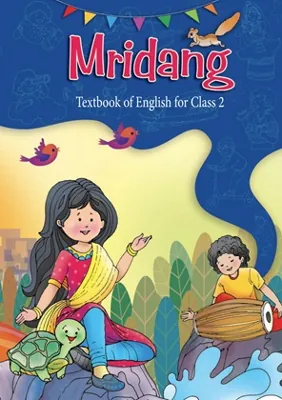
EnglishClass 2

Mridang

English Textbook13 Chapters

Chapter notes

What you'll learn in Mridang

A quick revision map of Mridang — the core idea and five key takeaways from each chapter. Tap any chapter to read the full NCERT PDF and detailed notes.

01

My Bicycle

Chapter 1 of the Class 2 English NCERT textbook (Mridang), "My Bicycle", introduces young learners to a simple poem about a child who rides a red bicycle, and builds language skills through vocabulary, listening, speaking, and writing activities.

  • 1The child in the poem rides a red bicycle with a blue seat and black tyres and pedals.
  • 2The bicycle bell makes a 'trin trin trin' sound to tell friends to move aside.
  • 3Air in the tyres is all the bicycle needs to keep moving.
  • 4The child wears a little helmet while riding the bicycle.
  • 5New words in the chapter include pedal, aside, helmet, track, and everywhere.
02

Picture Reading

Chapter 2 of the Class 2 English NCERT textbook (Mridang), "Picture Reading", tells a short story about two children, Jeet and Babli, who play bat and ball on a holiday and teaches vocabulary, sight words, opposites, and how to join sentences with "and".

  • 1Jeet and Babli are the two main characters who play together on a holiday.
  • 2The children play skipping rope and hide and seek before switching to bat and ball.
  • 3Their ball is lost when it lands in Mohit's locked garden.
  • 4Babli makes a new ball using rags, paper, wool, and string.
  • 5When Jeet hits the new homemade ball hard, it bursts open and Babli shouts 'OUT! OUT!'
03

It is Fun

Chapter 3 of the Class 2 English NCERT textbook (Mridang), "It is Fun", presents a cheerful poem in which a child imagines acting like different animals — leaping like a lamb, climbing like a cat, hopping like a frog, swimming like a fish, trotting like a horse, and flying like a bird — and includes speaking, writing, and thinking activities that build action words, animal vocabulary, and the use of the pronoun "I".

  • 1The poem says it is fun to leap like a lamb, climb like a cat, hop like a frog, swim like a fish, trot like a horse, and fly like a bird.
  • 2The child in the poem says "I can act just like them all" — meaning the child can imitate all these animals.
  • 3New vocabulary words in this chapter are: fun, climb, leap, swim, trot, and fly.
  • 4Sight words to learn are: this, that, like, to, them, all, none.
  • 5A matching activity links animals to their actions — the horse trots, the lamb leaps, the snake crawls, the squirrel runs, and the monkey swings.
04

Seeing without Seeing

Chapter 4 of the Class 2 English NCERT textbook (Mridang), "Seeing without Seeing", tells the story of Onshangla and her mother Ava, who play a blindfold game to help Onshangla understand how a classmate who cannot see can still identify things through touch, smell, taste, and hearing.

  • 1Onshangla is a Class 2 girl who comes home quiet after a new boy who cannot see joins her class.
  • 2Her mother Ava plays a blindfold game by tying a scarf over Onshangla's eyes.
  • 3Onshangla identifies a rose by touch and smell, a bell by sound, and a glass of orange juice by touch and taste.
  • 4Ava teaches that people who cannot see can use other senses to find out about the world.
  • 5New vocabulary words in the chapter include quiet, sniff, remove, joy, blink, and difficulties.
05

Come Back Soon

Chapter 5 of the Class 2 English NCERT textbook (Mridang), "Come Back Soon", is a fun poem about different ways to travel — bus, train, boat, plane, taxi, car, and even a rocket to the moon — followed by speaking, listening, drawing, and writing activities that help children learn transport vocabulary, the vowel sound "u", and how to sort vehicles by land, air, and water.

  • 1The poem names seven modes of transport: bus, train, boat, plane, taxi, car, and rocket.
  • 2The rocket verse tells the reader they can go all the way to the moon, but must come back soon.
  • 3Sight words in this chapter include: take, is, the, or, two, may be.
  • 4New words introduced are: train, boat, plane, taxi, near, rocket.
  • 5The listening poem uses action commands: stop, stand, sit, raise your hand, jump, and run.
06

Between Home and School

Chapter 6 of the Class 2 English NCERT textbook (Mridang), "Between Home and School", follows Ravi and his friend as they walk to school through paddy fields, a mango grove, and the main road, and teaches the consonant blend "ch", action words, vocabulary from the journey, and fun activities like drawing a route map and making sentences.

  • 1Ravi and his friend walk to school through paddy fields, a mango grove, and the main road.
  • 2The route they take is the shortest one from home to school.
  • 3They jump over canals, climb trees, swing from branches, and watch lizards along the way.
  • 4Despite the fun activities, Ravi and his friend always reach school on time.
  • 5New words in the chapter include paddy, grove, route, canals, branches, and lizards.
07

This is My Town

Chapter 7 of the Class 2 English NCERT textbook (Mridang), "This is My Town", takes young readers on a journey from town to street to house to room to bed to basket, building vocabulary about places and things around us through a simple, repetitive poem and activities on writing an address, listening for sounds, and practising the "sh" blend.

  • 1The poem moves from town → street → house → room → bed → basket → flowers, then reverses back to town.
  • 2Sight words practised: in, this, that, there, my.
  • 3New vocabulary words: town, street, house, flower, basket, train.
  • 4Children write their own full home address as a writing activity.
  • 5A listening task uses rhyming word pairs such as fan/fin and house/mouse.
08

A Show of Clouds

Chapter 8 of the Class 2 English NCERT textbook (Mridang), "A Show of Clouds", is a poem about a child who lies on their back, looks up at the sky, and imagines cloud shapes as a bear, a sailing ship, and an elephant waving its trunk.

  • 1The poem repeats the line 'As I lie on my back, looking up at the sky' in every verse.
  • 2The child sees three cloud shapes: a big white bear, a ship sailing on a white sea, and an elephant waving its trunk.
  • 3The last verse says 'Oh! It's fun, it's fun to me, to see whatever I want to see.'
  • 4Sight words taught in this chapter include: as, up, at, my, sky, back.
  • 5New vocabulary words are: lie, bear, sea, sailing, waving.
09

My Name

Chapter 9 of the Class 2 English NCERT textbook (Mridang), "My Name", tells the story of a little fly who forgets his name and asks a chain of characters — an ant, a tree, a cow, grass, and a leaf — until he remembers it on his own, and also introduces consonant blends, animal sounds, and vocabulary activities.

  • 1A little fly forgets his name and asks an ant, a tree, a cow, grass, and a leaf for help.
  • 2No one knows the fly's name — each character sends the fly to the next one.
  • 3When the wind blows and a leaf begins to fly, the fly remembers his own name.
  • 4The fly's name is Fly — he says 'My name is Fly!' happily at the end.
  • 5The chapter introduces the consonant blends bl (blue, black, blanket) and pl (plum, plate, plant).
10

The Crow

Chapter 10 of the Class 2 English NCERT textbook (Mridang), "The Crow", tells the story of a black crow who collects peacock feathers to look beautiful, only to be reminded by other crows that he is already beautiful just as he is.

  • 1A black crow collects peacock feathers to look beautiful — he sticks them in his tail, wings, and on his head.
  • 2The other crows tell the crow he is already beautiful in black and they love him for what he is.
  • 3New words in the chapter include colourful, feather, wings, peacock, beautiful, and fool.
  • 4Sight words practised include once, as, how, one, all, now, and it.
  • 5The listening activity teaches children to break words into syllables by clapping — for example, pea-cock, fea-ther, beau-ti-ful.
11

The Smart Monkey

Chapter 11 of the Class 2 English NCERT textbook (Mridang), "The Smart Monkey", tells the story of two girls, Anju and Farida, who learn about keeping their surroundings clean after watching a monkey throw its banana peel into a dustbin.

  • 1Anju and Farida went to the market and bought a bag, a water bottle, groundnuts, and juice.
  • 2They sat on a bench under a tree to rest, not noticing a monkey on the branch above.
  • 3The monkey peeled a banana, ate it, and threw the banana peel into a dustbin.
  • 4Anju and Farida had thrown their empty packet and juice bottle on the ground.
  • 5After seeing the monkey use the dustbin, the girls felt ashamed and picked up their litter.
12

Little Drops of Water

Chapter 12 of the Class 2 English NCERT textbook (Mridang), "Little Drops of Water", teaches children that small things — tiny drops of water, little grains of sand, and small acts of kindness — together create something mighty and beautiful.

  • 1The poem says little drops of water and grains of sand make the mighty ocean and the pleasant land.
  • 2Small words of love, acts of kindness, and deeds of warmth spread smiles and happiness.
  • 3New vocabulary in this chapter includes: mighty, pleasant, kindness, peaceful, and ocean.
  • 4Children learn that 'drops of' is used with liquids such as water, milk, juice, and oil — not with solids like bread or rice.
  • 5A writing exercise teaches children to use container words: a cup of milk, a slice of bread, a tube of toothpaste, a bag of pencils, a box of clothes.
13

We are all Indians

Chapter 13 of the Class 2 English NCERT textbook (Mridang), "We are all Indians", introduces children from twelve different Indian states who share their languages, festivals, and favourite things, ending with the message that each person is unique but all are Indians.

  • 1Twelve children from twelve Indian states introduce themselves — Tamil Nadu, Gujarat, Rajasthan, Bengal, Punjab, Maharashtra, Uttar Pradesh, Manipur, Karnataka, Andhra Pradesh, Odisha, and Kerala.
  • 2Languages named in the chapter include Tamil, Gujarati, Bengali, Punjabi, Marathi, Manipuri, Kannada, Telugu, Odia, and Malayalam.
  • 3The chapter ends with the message: "But we are all Indians. Each of us is unique."
  • 4New vocabulary words introduced are: festival, puppet, travel, painting, neighbour, and fingerprints.
  • 5The chapter teaches consonant blends — br words (bread, bridge, brown) and fr words (frock, frame, frog).

Want offline access with notes & solutions?

Download CBSE Prepmaster for free — includes NCERT solutions, flashcards, mock tests & more.

Download Free App