ScienceClass 6

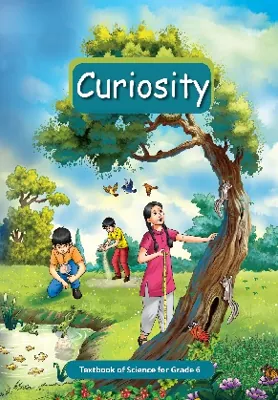
Curiosity

Science Textbook12 Chapters

Chapter notes

What you'll learn in Curiosity

A quick revision map of Curiosity — the core idea and five key takeaways from each chapter. Tap any chapter to read the full NCERT PDF and detailed notes.

01

The Wonderful World of Science

Chapter 1 of the Class 6 Science NCERT textbook (Curiosity), "The Wonderful World of Science", introduces science as a way of thinking, observing and doing things to understand the world, and teaches the scientific method through everyday examples like a pen that stops writing.

  • 1Science is defined as a way of thinking, observing and doing things to understand the world and uncover the secrets of the universe.
  • 2Curiosity is the most important quality for science — it is also the title of the Class 6 NCERT Science textbook.
  • 3The scientific method has five steps: observe something interesting, form a question, make a guess, test the guess through experiments or observations, and analyse the results.
  • 4If the analysis shows the guess was wrong, a new guess is made and tested — the method is iterative, not linear.
  • 5Science is compared to a 'giant and unending jigsaw puzzle' — every new discovery adds a piece but also generates more questions, so science has no final end.
02

Diversity in the Living World

Chapter 2 of the Class 6 Science NCERT textbook (Curiosity), "Diversity in the Living World", explores the variety of plants and animals around us, how they are grouped, the features that help them survive in different habitats, and why protecting biodiversity matters.

  • 1Biodiversity refers to the variety of plants and animals found in a particular region; each member plays a different role in the ecosystem.
  • 2Plants are grouped as herbs (soft green stems, small), shrubs (woody stems branching close to the ground), and trees (tall, hard thick woody stems with branches higher up).
  • 3Climbers use support structures to grow upward; creepers grow along the ground.
  • 4Venation is the pattern of veins on a leaf: reticulate venation (net-like, e.g. hibiscus) and parallel venation (e.g. banana, grass).
  • 5Taproot system has one main root with side roots (e.g. mustard, chickpea); fibrous roots are a bunch of similar-sized thin roots from the stem base (e.g. grass, wheat).
03

Mindful Eating: A Path to a Healthy Body

Chapter 3 of the Class 6 Science NCERT textbook (Curiosity), "Mindful Eating: A Path to a Healthy Body", teaches students about food components (carbohydrates, proteins, fats, vitamins, minerals, roughage, and water), deficiency diseases, balanced diet, millets, food miles, and how to test nutrients in food.

  • 1The Sanskrit saying 'annena jātāni jivanti' means 'food gives life to living beings'.
  • 2Traditional food of any state is based on crops grown in that region, varying by soil, climate, culture, and traditions.
  • 3Carbohydrates (wheat, rice, potato, banana) and fats (ghee, nuts, seeds) are energy-giving foods; fats store energy.
  • 4Proteins (pulses, paneer, egg, fish) are body-building foods that help in growth and repair.
  • 5Vitamins and minerals are protective nutrients required in small amounts; deficiency causes specific diseases.
04

Exploring Magnets

Chapter 4 of the Class 6 Science NCERT textbook (Curiosity), 'Exploring Magnets', introduces magnets and their poles, magnetic and non-magnetic materials, how a freely suspended magnet always points north–south, and the principles of attraction and repulsion between magnets.

  • 1Naturally occurring magnets are called lodestones; modern magnets used in labs, toys, and pencil boxes are artificial magnets.
  • 2Magnetic materials (iron, nickel, cobalt) are attracted towards a magnet; non-magnetic materials (wood, plastic, glass, rubber) are not.
  • 3Every magnet has two poles — the North pole and the South pole — located at its ends, where magnetic force is strongest.
  • 4Magnetic poles always exist in pairs. Breaking a magnet into smaller pieces always produces smaller magnets, each with both a North and South pole — a single pole (monopole) cannot exist.
  • 5A freely suspended magnet always comes to rest along the north-south direction because Earth itself behaves like a giant magnet.
05

Measurement of Length and Motion

Chapter 5 of the Class 6 Science NCERT textbook (Curiosity), "Measurement of Length and Motion", covers measurement of length using standard SI units (metre, centimetre, millimetre, kilometre) and introduces three types of motion — linear, circular, and oscillatory — along with the concept of a reference point.

  • 1The SI unit of length is the metre (m); other units are kilometre (1 km = 1000 m), centimetre (1 m = 100 cm), and millimetre (1 cm = 10 mm).
  • 2Body-part units like handspan (balisht) are non-standard because they differ from person to person, which is why SI units were adopted internationally.
  • 3Ancient Indian units of length include angula (finger width), dhanusa, and yojana; angula is still used by traditional craftspeople.
  • 4When using a scale: place it in contact with the object along its length; keep the eye directly above the measurement tip to avoid parallax error.
  • 5If the zero end of a scale is broken, start at any clear mark and subtract that reading from the other-end reading to find the true length.
06

Materials Around Us

Chapter 6 of the Class 6 Science NCERT textbook (Curiosity), "Materials Around Us", introduces materials — substances used to make objects — and explores their properties including lustre, hardness, transparency, solubility, mass, and volume, leading to the definition of matter.

  • 1A material is any substance used to create an object — examples include paper, wood, glass, metal, plastic, and clay.
  • 2Classification is the method of arranging objects into groups based on a common property.
  • 3Lustrous materials (e.g., metals like iron, copper, gold) have shiny surfaces; non-lustrous materials (e.g., paper, wood, rubber) do not.
  • 4Hard materials resist compression and scratching (e.g., stone, iron); soft materials compress or scratch easily (e.g., eraser, sponge). Hardness is a relative property.
  • 5Transparent materials allow clear vision through them (glass, water, air); opaque materials block vision completely (wood, cardboard, metals); translucent materials allow partial vision (frosted glass, butter paper).
07

Temperature and its Measurement

Chapter 7 of the Class 6 Science NCERT textbook (Curiosity), "Temperature and its Measurement", teaches students what temperature is, how it is measured using clinical and laboratory thermometers, and the three scales — Celsius, Fahrenheit, and Kelvin — used to express it.

  • 1Temperature is a reliable measure of the hotness or coldness of a body; our sense of touch can be misleading.
  • 2A thermometer is a device used to measure temperature.
  • 3The two common thermometers are the clinical thermometer (for body temperature) and the laboratory thermometer (for other purposes).
  • 4Normal human body temperature is 37.0 °C (98.6 °F); it does not normally go below 35 °C or above 42 °C.
  • 5Mercury thermometers have been replaced by digital thermometers because mercury is extremely toxic.
08

A Journey through States of Water

Chapter 8 of the Class 6 Science NCERT textbook (Curiosity), "A Journey through States of Water", explores the three states of water — solid (ice), liquid (water), and gaseous (water vapour) — and the processes of evaporation, condensation, melting, freezing, and the water cycle.

  • 1Ice and water are the same substance — water — existing in different states (solid and liquid respectively).
  • 2The three states of water are: solid (ice), liquid (water), and gaseous (water vapour).
  • 3Evaporation is the conversion of water into its vapour state; it occurs continuously even at room temperature.
  • 4Condensation is the conversion of water vapour into liquid water, occurring when vapour contacts a cold surface.
  • 5Melting (solid → liquid) and freezing (liquid → solid) are opposite processes caused by heating or cooling.
09

Methods of Separation in Everyday Life

Chapter 9 of the Class 6 Science NCERT textbook (Curiosity), "Methods of Separation in Everyday Life", covers the different methods used to separate mixtures in everyday life, including handpicking, threshing, winnowing, sieving, evaporation, sedimentation, decantation, filtration, churning, and magnetic separation.

  • 1Handpicking separates substances from a mixture based on differences in size, colour, and shape; best when the component to be removed is in small quantities.
  • 2Threshing separates grains from stalks by beating the stalks on a wooden log; modern threshers also perform winnowing simultaneously.
  • 3Winnowing uses wind or blowing air to separate lighter husk from heavier grains; a soop (bamboo tray) is the traditional tool.
  • 4Sieving is used for solid-solid mixtures with different particle sizes; fine flour passes through holes while larger particles like bran stay on the sieve.
  • 5Evaporation converts a liquid into vapour, leaving behind a dissolved solid; used to obtain common salt from seawater kept in shallow pits.
10

Living Creatures: Exploring their Characteristics

Chapter 10 of the Class 6 Science NCERT textbook (Curiosity), "Living Creatures: Exploring their Characteristics", explores what makes living creatures different from non-living things by examining eight key characteristics: movement, nutrition, growth, respiration, excretion, response to stimuli, reproduction, and death.

  • 1All living beings share eight characteristics: movement, nutrition, growth, respiration, excretion, response to stimuli, reproduction, and death. Absence of any indicates a non-living thing.
  • 2Breathing is part of respiration. Plants respire through tiny pores called stomata on the surface of leaves.
  • 3Excretion is the removal of waste products. Sweat (water + salts) and urine are animal excretions; plants excrete excess water and minerals as droplets on leaves (e.g., grasses, roses).
  • 4A stimulus is anything that prompts a living being to respond. Touch-me-not (chhui-mui) folds leaves when touched; amla tree leaves fold after sunset in response to changing light.
  • 5Bean seed germination requires the right amount of water and air. Most seeds do NOT need light to germinate; sunlight is needed only for seedling growth after germination.
11

Nature's Treasures

Chapter 11 of the Class 6 Science NCERT textbook (Curiosity), "Nature's Treasures", explores the key natural resources — air, water, solar energy, forests, soil, rocks, minerals, and fossil fuels — and teaches students how to classify, conserve, and use them responsibly.

  • 1Air is a mixture of gases: nitrogen (78%), oxygen (21%), and argon, carbon dioxide and other gases (1%).
  • 2We can survive without food or water for a few days but cannot survive without oxygen for even a few minutes.
  • 3Moving air is called wind; windmills use wind energy to run flour mills, pump water, and generate electricity.
  • 4Water covers about two-thirds of Earth's surface; most is saline ocean water not fit for use — freshwater is limited and precious.
  • 5Rainwater harvesting (e.g., Bawadi stepwells in Rajasthan, Vav in Gujarat) is an age-old Indian practice to conserve water.
12

Beyond Earth

Chapter 12 of the Class 6 Science NCERT textbook (Curiosity), "Beyond Earth", introduces students to stars, constellations, the Solar System, the Moon, asteroids, comets, the Milky Way Galaxy, and the Universe.

  • 1Constellations are defined sky regions often containing recognisable star patterns; the IAU officially listed 88 constellations.
  • 2Star patterns were used for navigation before the magnetic compass; the Pole Star (Polaris/Dhruva tara) appears nearly stationary in the North and helps find direction.
  • 3Sirius in Canis Major is the brightest star in the night sky; Orion (the hunter) is best viewed in India from December to April.
  • 4The Sun is a star — a hot spherical ball of gases about 100 times bigger than Earth in diameter, located 150 million km (1 au) from Earth.
  • 5The eight planets in order from the Sun: Mercury, Venus, Earth, Mars, Jupiter, Saturn, Uranus, Neptune. Inner four are small with rocky surfaces; outer four are giant gas-and-ice planets with ring structures.

Want offline access with notes & solutions?

Download CBSE Prepmaster for free — includes NCERT solutions, flashcards, mock tests & more.

Download Free App