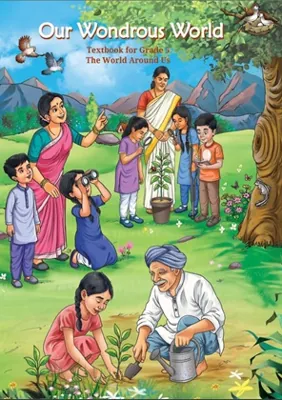
The World Around UsClass 5

Our Wondrous World

Environmental Studies10 Chapters

Chapter notes

What you'll learn in Our Wondrous World

A quick revision map of Our Wondrous World — the core idea and five key takeaways from each chapter. Tap any chapter to read the full NCERT PDF and detailed notes.

01

Water — The Essence of Life

Chapter 1 of the Class 5 The World Around Us NCERT textbook (Our Wondrous World), "Water — The Essence of Life," introduces students to the forms and sources of water, the water cycle, groundwater, surface water, and freshwater habitats — download the PDF and read a summary of how water shapes the land and supports all living beings on Earth.

  • 1Most of Earth's water is salty; freshwater is so scarce that if all Earth's water filled a 200 ml glass, freshwater would be only about 5 ml.
  • 2Water exists in three forms: liquid (rain, rivers), solid (ice, snow, glaciers), and vapour (steam, clouds).
  • 3The water cycle is the continuous movement of water — evaporation from water bodies, cloud formation, and precipitation back to Earth as rain, snow, or hail.
  • 4Rainwater that soaks into the ground and is stored in rock layers is called groundwater; it is drawn up through wells, borewells, and handpumps.
  • 5Rivers begin in mountains and flow downhill, shaped by the land; Indian rivers flow either toward the Bay of Bengal or the Arabian Sea depending on the terrain.
02

Journey of a River

Chapter 2 of the Class 5 The World Around Us NCERT textbook (Our Wondrous World), "Journey of a River", follows the Godavari river from its origin in the Western Ghats to the Bay of Bengal — download the PDF and read a summary of how rivers form, support life, face pollution, and cause floods.

  • 1The Godavari originates at Trimbakeshwar in the Western Ghats of Maharashtra and is India's second longest river after the Ganga, travelling 1,465 kilometres to reach the Bay of Bengal.
  • 2Small streams called tributaries join a river along its journey, making it wider and stronger as it moves across the land.
  • 3A perennial river like the Godavari flows all year round, while seasonal rivers only flow during the rainy season.
  • 4When a river reaches the sea it can spread into many small streams forming a delta; the Godavari ends at the Coringa Mangrove Forests.
  • 5Dams store water for drinking, farming, and electricity, but they also flood land that was home to animals and people, forcing them to move.
03

The Mystery of Food

Chapter 3 of the Class 5 The World Around Us NCERT textbook (Our Wondrous World), "The Mystery of Food", follows detective Disha as she uncovers why food spoils, how microbes cause it, and the science behind traditional preservation methods — download the PDF and read a summary of food spoilage, drying, pickling, refrigeration, teeth, and oral hygiene as taught in the chapter.

  • 1Microbes are microscopic living things visible only under a microscope; a visible patch of mould is a colony of thousands of them.
  • 2Microbes need moisture, air, and the right temperature to grow — removing any one of these stops spoilage.
  • 3Drying in the sun removes moisture from foods like chillies, letting them last the whole year as chilli powder.
  • 4Covering pickles with oil keeps air out and prevents microbial growth, which is why Paati's mango pickles stayed fresh for months.
  • 5Cold temperatures in a refrigerator slow down microbes, preserving milk, vegetables, butter, and other perishables.
04

Our School — A Happy Place

Chapter 4 of the Class 5 The World Around Us NCERT textbook (Our Wondrous World), "Our School — A Happy Place", guides students to observe and improve their school environment through waste management, water conservation, energy saving, greenery, traffic safety, fire safety, and respectful behaviour — download the PDF to read the full activities, discussion prompts, and reflection exercises.

  • 1A green school manages waste, saves water, uses electricity carefully, and grows more trees and plants on campus.
  • 2Students can form 'School Explorer Teams' — Water Watchers, Electricity Savers, Waste Warriors, Green Guardians, and Traffic Trackers — to survey their school and report findings.
  • 3Swachh Bharat Swachh Vidyalaya (Clean India Clean Schools), part of the Swachh Bharat Mission, promotes clean toilets, safe drinking water, waste management, and hygiene education in schools.
  • 4Waste should be separated into wet waste, dry waste, and items for recyclers; old newspapers and similar items are traditionally set aside for recyclers rather than placed in bins.
  • 5A white-painted roof reflects the sun's heat and keeps a building cooler, while a black surface absorbs heat — students can verify this by comparing black and white tiles left in sunlight.
05

Our Vibrant Country

Chapter 5 of the Class 5 The World Around Us NCERT textbook (Our Wondrous World), "Our Vibrant Country", explores India's diversity through national symbols, currency notes, languages, clothing, music, and dance — download the PDF and read a summary of how unity is woven through India's rich cultural variety.

  • 1Republic Day is celebrated on 26 January because on that day in 1950, India adopted its Constitution — the book of rules that guides the country.
  • 2The saffron band on the National Flag stands for strength and courage; white stands for peace and truth; green stands for growth and prosperity. The blue Ashoka Chakra at the centre represents duty (dharma).
  • 3Indian currency notes carry two images of Mahatma Gandhi (the second visible only when held up to light), the National Emblem, multiple languages, and monuments from across India.
  • 4The spectacles symbol on currency notes represents the Swachh Bharat Abhiyan (Clean India Mission), inspired by Gandhi ji's own spectacles and his insistence on cleanliness.
  • 5More than a thousand languages are spoken across India, making it one of the most multilingual countries in the world.
06

Some Unique Places

Chapter 6 of the Class 5 The World Around Us NCERT textbook (Our Wondrous World), "Some Unique Places", takes students on a journey from the Andaman and Nicobar Islands through the Sundarbans and Northeast India to the Western Ghats — download the PDF and read a summary of each region's special plants, animals, and the people who depend on them.

  • 1India has around 75 per cent of the world's wild tigers, and the Andaman and Nicobar Islands are home to birds like the Andaman wood pigeon and Andaman hornbill found nowhere else.
  • 2The Sundarbans is the largest mangrove forest in the world; mangrove roots that stick out of the water help the trees breathe in muddy, salty soil.
  • 3The people of North Sentinel Island in the Andamans live as hunter-gatherers and may have survived the 2004 tsunami by reading natural signs like changes in wind, sea, and animal behaviour.
  • 4Northeast India is known for the living root bridges in Meghalaya, where tree roots across streams have grown strong enough to walk on, and for Bhut Jolokia (ghost pepper), one of the hottest chillies in the world.
  • 5The Western Ghats has over 50 protected areas, and a community survey of the region recorded over 200 types of mangoes growing there.
07

Energy — How Things Work

Chapter 7 of the Class 5 The World Around Us NCERT textbook (Our Wondrous World), "Energy — How Things Work", explains what energy is and how it drives everything from movement and sound to heat and light — download the PDF and read a summary of how food, fuel, electricity, and clean sources like the Sun, wind, and water all power the world around us.

  • 1Energy is what makes things move, produce sound, light up, or change temperature — it is behind every activity we see in nature and at home.
  • 2Food is the source of energy for all living things, including humans and animals; petrol and diesel fuel vehicles.
  • 3Burning coal is the main way most electricity is produced today, but it releases smoke and harmful gases that pollute the air.
  • 4Solar panels, windmills, and flowing water can generate electricity without causing pollution — this is called clean energy.
  • 5The Bhadla Solar Park in Rajasthan is one of the largest solar power plants in the world; Cochin International Airport in Kerala runs entirely on solar energy.
08

Clothes — How Things are Made

Chapter 8 of the Class 5 The World Around Us NCERT textbook (Our Wondrous World), "Clothes — How Things are Made", explains how fibres become threads and threads become cloth through spinning and weaving — download the PDF and read a summary covering natural fibres, handloom traditions, embroidery, and the life cycle of the silkworm.

  • 1The male baya weaverbird weaves grass strands over and under to build a strong, pouch-shaped hanging nest — the same over-under technique humans use to weave cloth.
  • 2India has been weaving cloth for over 4,000 years, and the Indian handloom sector employs over 45 lakh people, especially women and rural artisans.
  • 3Spinning is the process of twisting cotton fibres together to make thread or yarn; a charkha (spinning wheel) is the tool used for this.
  • 4Silk comes from the cocoon of the silk moth: cocoons are placed in hot water, the thread is pulled out, and it is made into silk fabric.
  • 5Natural fibres include cotton, wool, silk, linen, jute, and bamboo; synthetic fibres include nylon, polyester, terylene, and rayon.
09

Rhythms of Nature

Chapter 9 of the Class 5 The World Around Us NCERT textbook (Our Wondrous World), "Rhythms of Nature", explores how the world changes around us through day and night, seasons, and the repeating patterns that shape plant life, animals, weather, and human activities — download the PDF and read a summary of India's six seasons, the cause of day and night, seasonal festivals, and hands-on journaling activities.

  • 1It is the Earth that rotates, not the Sun — this rotation causes day and night, as shown through a torch-and-globe classroom demonstration.
  • 2India celebrates over 1,000 festivals throughout the year, many of which are connected to seasonal and harvest cycles.
  • 3India has six seasons: Vasanta, Grishma, Varsha, Sharad, Hemant, and Shishir.
  • 4India hosts both the wettest place on Earth (Mawsynram in Meghalaya) and one of the driest (the Thar Desert), showing how seasons differ across regions.
  • 5Dong in Arunachal Pradesh is known as India's First Village of the Sunrise — the first place where the Sun's rays touch Indian land each morning.
10

Earth — Our Shared Home

Chapter 10 of the Class 5 The World Around Us NCERT textbook (Our Wondrous World), "Earth — Our Shared Home", explores how people, animals, plants, and ideas travel across the world and connect us all — download the PDF and read a summary of stories about migratory birds, yoga, chillies, sugar, marigolds, and Indian cows that reveal how deeply every nation shares this one planet.

  • 1Group Captain Shubhanshu Shukla, the first Indian to reach the International Space Station, noted that from space no borders are visible — Earth looks completely one.
  • 2Rosy starlings migrate each winter from Russia and Mongolia to India, traveling thousands of kilometres and helping farmers by eating locusts and grasshoppers.
  • 3Yoga has been practised in India for more than 3,000 years; the United Nations declared 21 June as the International Day of Yoga in 2014.
  • 4Chillies are native to South America and reached India only 400 to 500 years ago, brought by Portuguese travellers; before chillies, Indians used black pepper to spice food.
  • 5The method of making jaggery from sugarcane juice, and then refining it into sugar, was first discovered in India and spread to the rest of the world through trade.

Want offline access with notes & solutions?

Download CBSE Prepmaster for free — includes NCERT solutions, flashcards, mock tests & more.

Download Free App